Wednesday, November 29, 2023

Guardian Monsters - Listed and Considered

There are a great number of guardian monsters to help spice up the role playing.   Guardian-type monsters are a regular feature in dramatic fantasy fiction, so even new players will relate to plot hooks predicated on guardian monster intervention.  
 
Lord of the Rings, for example, is essentially a guardian-monster-initiated adventure (Gandolf being the guardian monster).    The Gandolf example is apt, as many guardian monsters do have polymorph powers, so could assume the likeness of mankind.
 
 
Guardian Animals
 
For low-level campaigns, dealing with the local dangers of the heath and forest, some of the best guardian monsters you can use are Grims and Moondogs.   The great thing about the Grims and Moondogs is that they are elusive and mysterious, so the players would probably think they were part of the evil at first. 
 
Grims take the form of black dogs, black cats, or black owls.  The Harry Potter series used the "Grim plot hook" to great effect in book 3, when Harry kept seeing a large black canine stalking him in the shadows (which ended up being his guardian Sirius Black, of course). 
 
 
Guardians of Specific Places
 
Some guardians are encamped in a specific locale, working to disrupt and contain some evil from breaking out. 
 
Naga (guardian-types) would be well-used here.  From their description it seems clear they would not be likely to be "roaming" guardians.   I could see them patrolling a Yuan-Ti infested jungle, or the area around an evil temple...
 
Foo-Dogs and Foo-Lions are also described as guardians with powerful anti-evil powers.  They are described as chaotic, so would not make good long-term disciplined guardians, but they could be brought in as excellent shock troops in the battle against evil. 
 
Opinicus also appear to be well-suited to a role as guardians of some specific location.  They are especially equipped to deal with undead and demons, so they would be prone to be found guarding the approaches to dangerous areas full of such creatures, such as the forest around a vampire's castle or the mountains around lich's lair, for example. 
 
 
Wandering Guardian Monsters
 
The Agathion, Baku, Ki-rin, Lammasu, Hollyphant, and Shedu are the classic wandering guardian monsters.   They are all described as "roaming" guardians, seeking out and containing evil wherever they can find it. 
 
Most of them can polymorph into human form.  I imagine they would maintain some kind of contact with locals on the ground, gathering their information.  Naturally, such contact would tend to be with influential druids, clerics, magic users, or psionic warriors.
 
 
Dragon Guardians and Dragon Wars
 
Another creative idea would be to use a dragon, or even Bahamut the Platinum Dragon, as a guardian.  His description clearly describes his regular wandering.   No doubt he is gathering intelligence and keeping tabs on rising evil, ready to intervene if necessary.   I would imagine he would be especially vigilant against dragon problems, particularly related to his evil arch-nemesis Tiamat.  
 
I can imagine lots of plot hooks involving a "War Among the Dragons".  Imagine the poor people caught in the middle of those battles.  Of course, the good dragons would seek out the help of powerful humans of good alignment to assist in their battle.  The evil dragons would perhaps have some evil humans on their side, and let us not forget the Githyanki-Red Dragon alliance...
 
You gotta admit, campaigning a Dragon War would be pretty freakin epic. 
 
 
Good old-fashioned Guardian Angels
 
The ultimate guardian monsters are probably the "guardian angels" statted out in the 1e MM2 as Devas, Planetars, and Solars.    If you are doing a "human-centric" campaign, these would be perfect.  Perhaps especially if you are doing a "war of good vs evil, angels vs devils" type scenario.  Solars are so ridiculously over-powered, they would have to be used against Demon Lords and such. 
 
 
Guardian Monster Random Table
 
Or maybe you just need a guardian animal to bail your players out of a tight spot or severe challenge.  Here you go, in random tabular form:
 
01-20 Grim
21-30 Moondog
31-38 Naga, guardian
39-46 Foo-creature (75% dog, 25% lion)
47-53 Opinicus
54-60 Hollyphant
61-67 Agathion
68-74 Baku
75-81 Ki-rin
82-88 Lammasu (25% Greater Lammasu)
89-95 Shedu (25% Greater Shedu)
96-97 Dragon (10% Bahamut)
98-99 Deva
00 Planetar (25% Solar)


Thursday, July 15, 2021

The Psionicist class for 5th ed

 The Psion Mentalist is dedicated to the use of psionic powers to influence, manipulate, and dominate the minds of those around him.  He forgoes the development of psionic abilities of the body to instead focus on the disciplines of the mind.    

The Psion Mentalist must start with a 16 in at least one of the following abilities: INT, WIS, or CHA (to be eligible for psionic powers).    The Psion Mentalist starts with 6 hp and gains d6 hp per level.  

Weapons & Armor

The Psion Mentalist can choose any armor or weapons.     The Psion Mentalist gains additional armor and weapon proficiencies at the rate of Magic Users (1 every 6 levels)  

Class Proficiencies

INT, WIS, CHA, Animal Handling, Deception, Insight, Intimidation, Persuasion

Ability Score Improvement

When you reach 4th level, and again at 8th, 12th, 16th, and 19th level, you can increase one ability score of your choice by 2, or you can increase two ability scores of your choice by 1 (20 max).  Increases in INT, WIS, or CHA would increase psionic strength points (see below).

Starting Psionic Ability Points

Roll d100, adding 1 point to the total for each point of INT, WIS, and CHA score.

Additional Psionic Strength Points per level

+2d10 (maximum of 344 points)

Acquisition of Psionic Combat techniques (by level)

1st - Mind Blank &  Mind Thrust
2nd -  Thought Shield & Ego Whip
3rd  - Mental Barrier &  Id Insinuation 
4th -  Intellectual Fortress & Psychic Crush   
5th - Tower of Iron Will & Psionic Blast

Psion Mentalists acquire the following  psionic disciplines by level:

1st - Object Reading, Sensitivity to Psychic Impressions, Empathy, ESP
2nd – Detection of Good/Evil, Clairaudience, Hypnosis
3rd – Animal Telepathy, Detection of Magic, Clairvoyance,
4th – Aura Alteration, Telempathic Projection
5th – Telepathy, Invisibility
6th --   Mind Bar, Domination
7th –  Mass Domination, Precognition 
8th – Telepathic Projection
9th -- Astral Projection
10th –Cell Adjustment, Suspended Animation
11th - Energy Control (cancel energy attacks),
12th –Dimension Walk
13th – Dimension Door
14th-- Probability Travel (to parallel worlds/planes)


Sunday, July 8, 2012

Gnomes, Svirfneblin and the family of illusionist trickster Wee Folk

Gnomes are the only demi-human race in 1e who can become illusionists.  Gnomes are remarked as being cousins of the dwarfs, but just as equally, they appear to be cousins to the illusionist-trickster races.   In fact, it appears most likely that gnomes are  actually a half-breed race, resulting from the union of the Wee Folk and the Dwarf family.

In the DMG, they are described as "lively and full of humor - often on the black side or practical jokes".
They are described as living in homes: "sometimes based upon earthen burrows, although 75% of the time it will be made in rocky hill formations" (MM), and that they "enjoy the open world of growing things almost as much as their mines and burrows" (DMG).  In short, just as we would expect someone with the instincts of both Leprecauns and Dwarfs.

In the MM, they are rumored to have "magical abilities".  This is revealed in the PH to be illusionist skill, up to seventh class level (casting 4th level spells).  These innate illusionist  powers are developed more fully in the description of the Deep Gnomes, the Svirfneblin.

Svirfneblin: 3' tall with pointy ears, home: far beneath the surface of the earth
powers (1x per day):
blindness
blur
change self
non-detection and silent movement (constant)
unlikely to be surprised (1 in 12)
immune to illusion
(20-40% magic resistance)


Wee Folk - The  Illusionist Tricksters

The Wee Folk have been classified according to a number of different titles, including leprechauns, brownies, pixies, sprites, and bookas.  They seem to have a number of traits in common, suggesting they form something of a family group.

Their similarities to the Gnomes are manifold, including the pointy ears.   The MM suggests that Brownies and Leprechauns are the result of a Halfling/Pixie combination.  It seems just as likely that Gnomes are the result of a Dwarf/Leprechaun combination. 

Brownies: 1.5' tall with pointy ears, home: quiet, pastoral areas; "friendly but shy"
powers (1x per day):
invisibility in nature (at will)
ventriloquism
dancing lights
continual light
mirror image
confusion
dimension door
protection from evil
cannot be surprised

Leprechaun: 2' tall with pointy ears, home: fair, green lands with lush hills and dales; "mischievous nature"
powers (at will):
invisibility
polymorph non-living object
create illusion
ventriloquism

cannot be surprised
(80% magic resistance)

Pixie: 2.5' tall, with wings and pointy ears, home: most idyllic of woodlands, "highly mischievous"
powers (at will):
invisibility
polymorph self
create illusions (2x per day)
know alignment
cause confusion
dispel magic (1x per day)
dancing lights (1x per day)
ESP (1x per day)
Otto's Irresistible Dance (1x per day)
(25% magic resistance)

Also related:

Sprites: 2' tall, with wings and pointy ears; home: meadows and wooded glens, "shy and reclusive"
powers (at will):
invisibility
detect good/evil
move silently

Booka: 1' tall, with wings and pointy ears: home: attics, roofs, chimneys; "mischievous but hates evil"
powers (at will):
invisibility
(10% magic resistance)


Thursday, November 3, 2011

On the origins of Giants and giantism

Our society has long been plagued by the ravages of giant creatures. Throughout the years, numerous attempts have been made to sweep the hinterlands of dangerous giant beasts. No matter how successful the efforts at eradication, the giant beast always seem to reappear a year or two later.

Our Council of Sages, after extensive and dangerous investigation, has at last solved the riddle. The giant beasts are not members of giant animal species that can be eradicated. Rather, they are the result of some sort of natural process which turns normal animals into giants!

Giantism Mutation

This process, this giantism mutation, appears to be most associated with areas of high mana concentration, such as tall mountains, powerful rivers, natural springs, and cave openings. Beasts in those areas are born to normal-sized parents, but due to some magical enhancement, undergo a spectacular growth rate which vaults them to giant-status by the time they mature.

Giantism in Humans

It has been previously assumed that giantism in humans was related to the dark arts or dealings with demons. Many a witch has been burned at the stake when her child evidenced giantism. The Sages now recommend that the Trial by Burning sentence be considered non-mandatory in these cases, allowing the mothers of such children the opportunity to defend themselves in court before being wed to the Burning Man.

Origins of Giant Races

The Sages have even determined that the different mana sources produce different effects in the humans affected with giantism:

- the mana of the river waters produces the race of Storm Giants
- the mana of the volcano fields produces the black race of Fire Giants
- the mana of the underground caverns produces the race of Hill Giants
- the mana of the high mountains is more variable, producing either Stone or Cloud Giants.


As few adult females are ever seen among the Giants, perhaps boys are more prone to giantism then girls. Or perhaps the young human females who are cast out of their homes, when their parents see the giantism at work, are simply less able to survive into adulthood. At any rate, this discovery helps explain why no babies are ever seen among the Giants.

The Rise & Fall of Giant Hordes

This discovery also helps explain the rapid rise and fall of giant hordes, as well as their general state of primitive culture. Giant culture is primitive because all of them are essentially orphaned children, cast out of their homes and villages at a young age (the few that somehow escape the mandatory penalties, that is). As adults giants are unable to produce their own offspring, there is little continuation of culture among them.

Giant hordes tend to rise and fall as people move into areas with high mana. It is an odd twist of fate that these hordes, which usually end up destroying those advanced human settlements, are actually the children of the would-be settlers.

The dynamic goes something like this: after a generation or two of settlement, enough giants arise to be able to destroy the settlement. The lack of settlement leads to a lack of giants, allowing a later generation to attempt to settle the magically-rich area.

The lesson is clear, and has been emphasized by the Council of Sages: the mandatory sentence that falls upon children with giantism must be enforced with renewed vigor! Only when children with giantism are fully eliminated will human settlement in mana-rich regions be secured.

Friday, October 28, 2011

The Magic value of Gold

Magical power enters the material world following several well-known channels. The primary source is, of course, the sun. The moon, planets, and stars also exert their own magical influence.

However, magic also streams upward from below. Vocanoes and natural springs, as everyone knows, are locations of powerful magic. Items that have their origins in the earth often retain powerful magical properties, such as crystals and, of course, gold.

The Magical Properties of Gold

The obsessive attraction exerted by gold upon magical creatures is well-known, and of course, felt by humans as well to a certain degree.

Dragons are the most notorious hoarders of gold, jewels, and gems. The possession of these magically-potent items appears to be connected with the longetivity of those magical beasts.

Some have speculated that dragons consume the treasures as food, but this idea is contradicted by the fact that dragon hoards never seem to shrink, only grow. The well-attested observation of dragons swallowing piles of gold seems to be explained as the method by which the dragon carries the treasure back to its lair. Presumably the treasure is regurgitated bird-style into the dragon's hoard, although this has not been observed (by anyone who lived to tell of it) to this point....

The Hoard of the Goblin King

The lure of gold upon the subterrainean goblinoids is also well known, most legendarily in the case of the hoard of the goblin king. Goblins who lair amidst the piles of gold appear to grow large and strong, perhaps owing to the magical properties of the magic-charged gold itself. The gold also appears to be used in their mating practices, as the significant presence of gold in their breeding pens attests.

The Minotaur Lords of Bullhead City

The shifting labyrynths of Bullhead City are reported to be awash in gold. The multitude of aggressive and powerful minotaur who constantly struggle for dominance there, however, has precluded much investigation.

It has been noted, however, that minotaur encountered in the wilds can be distracted and/or diverted by the surrender of bags of gold. Examination of human victims of minotaur attacks indicates that the bullmen have no interest in humans as a food source, only as a source of wealth.

The Secrets of the Dwarven Mines

As everyone knows, the Dwarven Mines are rich in two items: gold and magic weapons. How the dwarves produce magic weapons has long been a mystery, as they show no aptitude for magical ability in any other sphere.

It is suspected that the dwarfs somehow harness great magical power from the gold (and other magic susbstances) as they harvest it from the rocks in their deep caverns. This magical over-exposure may account for madness that overcomes those few humans who attempt deep delves into the Dwarven Mines. The hearty natural anti-magical resistance of the Dwarfs seem to shield them from the ill-effects associated with repeated exposure to these high concentrations of magical power.

Tuesday, October 25, 2011

Being detected while Scrying - the perils of assisted-astral travel and remote viewing

Very interesting note on page 119 of the 1e DMG:

"Various devices for seeing at a distance (such as crystal balls, various scrying devices such as dishes or pans of water or mirrors, and spells such as clairaudience) are DETECTABLE."

The astral nature of remote viewing

The explanation for this potential detectability is the fact that they scrying device is a form of assisted astral travel. The astral spirit of the remote viewer actually goes to the location being viewed. That is why someone viewing a scrying device goes into a trance while viewing, as their spirit is actually undergoing astral travel, their conscious mind cannot be with their physical body.

Countering the Scrying Attempt

If the creature being observed is a magical creature/spell user/psionic, it has a change of realising that he is being observed.

Detection of Invisibility Table, pg.59 of the DMG
detection of invisibility table

As per the DMG, if the creature realizes he is being observed, he can cast a darkness or a dispel magic upon the spot of observation (described in the DMG as a "small disturbance in the air caused by the magical viewing"), which is the location of the remote viewer's astral body.

Vulnerability to astral attack

If the creature being observed, or anyone at the remote viewing location, has psionic powers or the ability to see into the astral plane, the remote viewer would also subject to psionic attack. Attempts at "soul capture", such as a magic jar, could be conceivable as well....

Tuesday, May 17, 2011

Devas - Astral and Psionic Monster Profile

Devas are basically angels: golden-skinned, amber-eyed, with white-but-gold-tinted-wings, tall, slender, and graceful, with a charisma effect of 20. 
 
According to the ancient concept (which I am duplicating in my AZ Adventures milieu), the Heavens were not on "another plane", they were above us, up in the sky.    That is where the Devas live, up in the sphere of the heavens.   Devas will be encountered on earth either physically or astrally.   
 
Astral Contact
 
As Devas can astrally project their spirits quickly through the heavens, astral contact will be more common.
 
In their astral form, they appear to people mainly in visions, especially in people's dream.  People with psychic sensitivity ("whose awareness extends to the ethereal and astral planes") could also see their astral forms while awake.  
 
Psychic mediums and shamans can also allow the devas to temporarily possess their bodies to deliver messages or do healings.  
 
While spirit-projected in the astral state, they can engage only in psionic combat, not physical combat.  In certain cases, their special powers could also be applied, but these could only be things that deal with the spiritual realm, not the physical realm, such as Know Alignment or Remove Fear.   
 
Physical Contact
 
On occasion, Devas might also physically journey down from the heavens to accomplish some task on earth, in person.   
 
As they can become invisible, go ethereal, polymorph self, and teleport at will, even while physically present, it might be hard to tell, as they can "come and go like a ghost". 
 
Even if their physical form is destroyed (which would be quite the trick, given their speed, etherealness, and teleport-at-will abilities), their astral spirit would return to their celestial home.
 
HD 9+36
attacks: Mace of Disruption: 2 strikes (4-15 +6 dam.)
INT: genius
Magic resistance: 65%, +1 to hit, immune to level drain, soul imprisonment, or death spells
 
Psionic Ability: 210
attacks: Psionic Blast, Mind Thrust, Ego Whip, Psychic Crush
defenses: Mind Blank, Thought Shield, Mental Barrier
 
Special Powers:
 
at will:
detect evil
detect illusion
detect magic
protection from evil
dispel illusion
dispel invisibility
know alignment
invisibility
light
polymorph self
read magic
remove curse
remove fear
teleport
tongues
ultravision
etherealness
 
 
7x per day:
cure light wounds
detect traps
 
3x per day:
cure disease
cure serious wounds
 
1x per day:
blade barrier
heal


Monday, May 16, 2011

Agathion -- Psionic Monster profile

The Agathion is NOT a classic monster. It is right there opposite the Aboleth at the beginning of the 1e MM2, bit it never made an impression on me, I think probably because it has no illustration.

Reviewing it now with more mature eyes, I see pure role-playing gold. Especially if you are running a psionic campaign, the Agathion is a must-have.

The Agathion has no picture, because it can take any form, even an object. They are basically manifestations of spirit beings who come for the specific purpose of combating some great evil.

I would explain them as stars, who look down upon the earth night after night, observing and seeing, finally putting on an earthly form to take action in some intrigue they have been observing from on high.

The natural form of these living "star creatures" is described as elf-like, with "opalescent, luminous" skin and shining eyes. Your players would only see this form if it was astrally traveling. Otherwise it will appear as follows:

Human form - 60%

Roll randomly to determine appearance.
Clerical spells per day (equal to 7th level cleric with 18 WIS): 1st level - 5, 2nd level - 5, 3th level - 3, 4th level - 2

Creature form - 30%

Attacks and spell powers of the form chosen (such as unicorn, lammasu, shedu, etc.).
Turns undead as 14th level cleric.

Object form - 10%

A ring, talisman, flask, vase, key, etc... Bestows on possessor:
1st level cleric spell ability, detect evil at will, turn undead as 6th level cleric

HD 7+7 (save as 14th level cleric)
attacks: as form, by weapon, or energy touch of 7-14 points
INT: Very to genius (11-18)
Magic resistance: 35% (+1 to hit), immune to level drain, death spells, disintegration, and negative energy attacks

Psionic ability: 177
attacks/defenses: all/all

Psionic powers (14th level):
clairaudience, clairvoyance, object reading, suspend animation, aura alteration, dimension walk, mind bar, telempathic projection

Other powers:

at will:
Etherealness
Astral Travel
detect evil
Telepathy (any language)

Friday, May 13, 2011

Astral Searchers & the perils of astral travel - hidden gem of the Fiend Folio

Astral Searchers are one of the real gems from the much-maligned 1e Fiend Folio. They are really quite terrifying if you think about it: disembodied spirits, roaming around the spirit world, trying to break into the material world, to find a body to possess.

While returning from astral travel, there is a chance that a bus-load of these things (4-24 of them!!!) will latch on to you, following you back into the material world. The FF postulates a 4% chance, but I'd say roll the good ole d20, them appearing on a 20 (a 5% chance).

Successfully following you into the material world, they immediately attack, trying to destroy your soul and take over your body! Yikes....

Clarifying the Origins


The FF speculates that Astral Searchers originate in traumatic events and spell-use in the astral plane. This is only the shadow of the real truth...

The true origins of Astral Searchers are the people who had their SILVER CORDS SEVERED while astrally projecting. Their spirits are then lost in the astral mists, and stuck there, unable to return to their true bodies. They will desperately latch onto anyone they can find, hoping to catch a ride back to the material world to reattain a physical form.

Clarifying the Mechanics

Essentially, what happens is, the Astral Searcher grabs onto the victim's body while it is on the astral plane, and "rides along" as it shifts into the material plane.

What they are talking about here is the Ethereal-to-Material transition. This transition happens when a physical body shifts phases from an astral state to a material state.

Purely "spirit-only" travel, projecting your astral body but not your physical body, would not involve any danger from these things, since, in that case, there is no astral-to-material transition.

Clarifying the Combat Mechanics

I must admit, I am a bit unsatisfied with the description of the combat mechanics. The problem is, they way they describe it, there is really no parallel for this anywhere else in the D&D rulebook.

Where exactly is the rule for "fighting an attempted spirit possession"??? According to the FF, here is how it works:

Your spirit has AC 5, but the same amount of hit points as your physical body. If it knocks you down to zero hit points, your spirit is considered crushed, destroyed forever, and it takes over your body....

For one, spirit possession does NOT involve the annihilation of the host soul. The invader "over-shadows" the host spirit, but if the invading spirit is exorcised, the host soul reasserts itself.

For two, isn't there some better mechanic for fighting spirit possession???

Spirit Possession mechanic of the Magic Jar

We already have a really good mechanic given in the 5th level magic user spell Magic Jar. This is precisely a spirit-invasion, hostile-take-over attempt of some else's body by an invading spirit.

In this spell, resistance to take-over is based on a savings throw, which is modified by comparing the INT+WIS scores of the two combatants.

The time of possession is also limited based on the relative INT+WIS scores. The victim gets a save every round, turn, day, or week depending on the comparable scores.

Also, the magician spell Mind Blank protects you from possession or soul trapping... Presumably the psionic defense of the same name would provide that protection, too...

This Magic Jar mechanic makes a lot more sense than the one described in the FF, so that is what I would follow.

The Astral Searcher could still attack physically with its 2hd form and 1-6 damage strike, but if it is going to attempt a spirit takeover, let's be consistent, shall we?

INT+WIS modifier for Savings Throw versus spirit possession:
Victim at +9 or more --> +4 on save, save each round
victim at +6, +7, +8 --> +3 on save, save each round
victim at +3, +4, +5) --> +2 on save, save each round
victim at even, +1, +2 --> + 1 on save, save each round
attacker at +1,2,3,or 4 --> no adjustment on save, save each round
attacker at +5,6,7,8 --> -1 on save, save each turn
attacker at +9, 10,11,12 --> -2 on save, save each day
attacker at +13 or more --> -3 on save, save each week

Grey Ooze, Yellow Mold, Algoid - Psionic plant life

The concept of psi-powered plant life is interesting. The basic idea in all of these cases is that a colony of microscopic plant life has attained some sort of rudimentary sentience.

Following this build-up of mental power, they can unleash a psionic attack. But because of their basic mindlessness, they remain immune to psionic counter-attacks.

Gray Ooze

Semi-sentient subterranean slime.... Can ooze around and lash out like a snake for physical damage. Will react to any use of psionic powers nearby (6" range) with a psionic attack of its own.

Psionic ability: 21-121
attack: Psychic Crush
defenses: immune to psionic attack

Yellow Mold

Semi-sentient mold colonies will attack physically by spore clouds, or psionically if psionic powers are used nearby (2"-12" range).

Psionic ability: 10-100
attack: Id Insinuation
defenses: immune to psionic attack

Algoid

The algoid is, at base, a psionic colony of algae. It represents a slight advance on previous psionic-slime types because it can also rise up in a humanoid shape to perform physical attacks as well control other plants around them.

Psionic ability: 101-120
attack: Psionic Blast
defenses: immune to psionic attack
special powers: control over nearby trees

Thursday, May 12, 2011

Dreaming Gods - license for creative DM'ing

[I was inspired by Quibish's concept of Dreaming Gods, over at his blog http://quibish.blogspot.com/2011/04/dreaming-gods.html. Check it out! Here is my take:]

The Dreaming Gods are not physical, manifesting in-your-face gods like the 1e Deities and Demigods (as far as I am concerned we can dispense with them).

The Dreaming Gods are known for their effects: zones of non-reality, as if gods are dreaming, called DreamLand. And you get sucked up into their dream.

--Their dream may be some sort of circus-funhouse-of-death megadungeon... [Rules of physics? What rules of physics?]

--Or maybe when you step into their dream, your characters are suddenly drawn into a game of Monopoly, or a game of Clue!

--Perhaps DreamLand is defined by a movie, or a book!

Be creative, this could get very fun.

Whatever the case is, the normal rules don't apply. Even the standard rolling procedures may need to be modified. [As you draw your +5 Vorpal Avenger, suddenly you are holding a bouquet of yellow roses, a small bee gently buzzing in its petals...]

It is part of the fun and challenge of the game play that your players have to figure out the rules on the fly, while being confronted with the challenges of the game.

The "dream" could even change if the players visited the same location later, or disappear for a time. The wise men say, "The Dreamer has awoken, he is not dreaming now..."

--Perhaps pilgrims wait in that spot, hoping to get caught up in the dream again...

--Perhaps some have emerged battered and insane from the DreamLand...

--Perhaps some disappear while in DreamLand, never to be seen on earth again...

The idea has certain things in common with traditional D&D elements. The classic modules EX1-2, Dungeonland and The Land Beyond the Magic Mirror, come to mind, as the PCs are transported into Alice's Wonderland.

It also reminds me of sci-fi author Robert Heinlein's book The Number of the Beast, wherein the characters discover that "fictional universes" are actually real.

Guardian Monsters - Listed and Considered

There are a great number of guardian monsters to help spice up the role playing. Guardian-type monsters are a regular feature in dramatic fantasy fiction, so even new players will relate to plot hooks predicated on guardian monster intervention.

Lord of the Rings, for example, is essentially a guardian-monster-initiated adventure (Gandolf being the guardian monster). The Gandolf example is apt, as many guardian monsters do have polymorph powers, so could assume the likeness of mankind.

Guardian Animals

For low-level campaigns, dealing with the local dangers of the heath and forest, some of the best guardian monsters you can use are Grims and Moondogs. The great thing about the Grims and Moondogs is that they are elusive and mysterious, so the players would probably think they were part of the evil at first.

Grims take the form of black dogs, black cats, or black owls. The Harry Potter series used the "Grim plot hook" to great effect in book 3, when Harry kept seeing a large black canine stalking him in the shadows (which ended up being his guardian Sirius Black, of course).

Guardians of Specific Places

Some guardians are encamped in a specific locale, working to disrupt and contain some evil from breaking out.

Naga (guardian-types) would be well-used here. From their description it seems clear they would not be likely to be "roaming" guardians. I could see them patrolling a Yuan-Ti infested jungle, or the area around an evil temple...

Foo-Dogs and Foo-Lions are also described as guardians with powerful anti-evil powers. They are described as chaotic, so would not make good long-term disciplined guardians, but they could be brought in as excellent shock troops in the battle against evil.

Opinicus also appear to be well-suited to a role as guardians of some specific location. They are especially equipped to deal with undead and demons, so they would be prone to be found guarding the approaches to dangerous areas full of such creatures, such as the forest around a vampire's castle or the mountains around lich's lair, for example.

Wandering Guardian Monsters

The Agathion, Baku, Ki-rin, Lammasu, Hollyphant, and Shedu are the classic wandering guardian monsters. They are all described as "roaming" guardians, seeking out and containing evil wherever they can find it.

Most of them can polymorph into human form. I imagine they would maintain some kind of contact with locals on the ground, gathering their information. Naturally, such contact would tend to be with influential druids, clerics, magic users, or psionic warriors.

Dragon Guardians and Dragon Wars

Another creative idea would be to use a dragon, or even Bahamut the Platinum Dragon, as a guardian. His description clearly describes his regular wandering. No doubt he is gathering intelligence and keeping tabs on rising evil, ready to intervene if necessary. I would imagine he would be especially vigilant against dragon problems, particularly related to his evil arch-nemesis Tiamat.

I can imagine lots of plot hooks involving a "War Among the Dragons". Imagine the poor people caught in the middle of those battles. Of course, the good dragons would seek out the help of powerful humans of good alignment to assist in their battle. The evil dragons would perhaps have some evil humans on their side, and let us not forget the Githyanki-Red Dragon alliance...

You gotta admit, campaigning a Dragon War would be pretty freakin epic.

Good old-fashioned Guardian Angels

The ultimate guardian monsters are probably the "guardian angels" statted out in the 1e MM2 as Devas, Planetars, and Solars. If you are doing a "human-centric" campaign, these would be perfect. Perhaps especially if you are doing a "war of good vs evil, angels vs devils" type scenario. Solars are so ridiculously over-powered, they would have to be used against Demon Lords and such.

Guardian Monster Random Table

Or maybe you just need a guardian animal to bail your players out of a tight spot or severe challenge. Here you go, in random tabular form:

01-20 Grim
21-30 Moondog
31-38 Naga, guardian
39-46 Foo-creature (75% dog, 25% lion)
47-53 Opinicus
54-60 Hollyphant
61-67 Agathion
68-74 Baku
75-81 Ki-rin
82-88 Lammasu (25% Greater Lammasu)
89-95 Shedu (25% Greater Shedu)
96-97 Dragon (10% Bahamut)
98-99 Deva
00 Planetar (25% Solar)

Saturday, April 30, 2011

Astral Travel and Astral Combat

Dealing with psionics means that you will also need to be familiar with the mechanics of the astral plane.


The astral plane is the spiritual counterpart of the material world. It is, literally speaking, "the spirit realm". It touches the material world at all points, being co-terminus with it, but on a different "wavelength".

Creatures enter the astral plane for various reasons, most usually related to travel. Traveling astrally is the preferred method, and sometimes the only method, for reaching the planets, the stars, and far distant celestial bodies. [Functionally, these can be treated as equivalent to the "other planes" in the neo-Gygaxian worldview.]

Traveling Astrally - the Basics

People can enter the astral plane in one of two ways: 1) spirit projection, or 2) ethereal translation of their material body.

If done through method one, the projected spirit is connected to the material body by a silver cord. This is preferred for long-distance travel. The spirit body travels at essentially "the speed of thought" through the astral plane.

If done through method two, the physical body itself does the traveling, while in an ethereal state. This is much slower. The material body cannot travel any faster while ethereal than physical, and usually, is actually slower. The astral plane is more like moving through water. Because it is not solid, it is difficult to be "walked through".

Rather, while in an ethereal state, the astral plane is easiest to be "swum through" or "flown through". Thus, most creatures who travel regularly through the astral plane have wings (or develop something like the Thought Eater's web paws). [The Githyanki have perfected the art of sailing through the astral sea using the gossamer web of the Phase Spider for sails.]

Implications for Astral Combat

If done through method one, the spirit body is essentiall "naked". The only offensive combat type available would be psionic combat. The astral body is vulnerable to psionic and other attacks that directly effect the spirit body, such as the energy-drain of the undead or certain special magic weapons. The astral body is not physical at all, so it is immune to purely physical attacks.

If done through method two, equipment and magical items can be brought along into the ethereal state, and the ethereal body is vulnerable to attack. Thus, two ethereal bodies could engage in regular combat against each other on the astral plane, using both physical and magic effects. [Think of Frodo being stabbed with the ethereal sword and visible to his pursuers while wearing the One Ring.] As long as they are on the same ethereal "wavelength", they are solid objects relative to each other.

An ethereal body can change wavelength to attack a material body, in a fashion such as a Phase Spider. An ethereal body can SEE purely astral bodies, but cannot affect them without special magic items or some other "spirit attacking" ability. The Githyanki silver sword is such an object, a magic item that can sever the silver astral cord.

The base chance for an encounter on the astral plane is 1 in 20, checked three times, at the beginning, middle, and at the end of the journey.

Becoming Lost on the Astral Plane

The silver cord prevents the projected astral body from becoming lost. An ethereal body, however, can very easily get lost in the dark, gloomy, and windy astral plane. This is another reason that ethereal travel tends to be for very short distances only.

The most significant cause of becoming lost in an ethereal state involve an Ether Cyclone, which is a powerful storm version of the Psychic Wind. Basically, traveling in the astral plane is like swimming in the ocean, making the traveler subject to currents and whirlpool-like effects.

In Appendix C (pg. 181) of the 1e DMG, Gygax recommends a 5% (1 in 20) chance (for a short-hop trip) that an astral projection or ethereal journey will be disrupted by an astral current of some sort.

If Astrally Projected

1-12 --> slows travel, one additional check for random encounter

13-16 --> blown off course, lost for 2-20 days, extra check for encounter each day, then return to starting place

17-19 --> blown off course, arrives at an unintended destination

20 --> dangerous storm, save vs magic or have silver cord snapped, lost for 4-40 days, extra check for encounter each day, then return to starting place

If Ethereal traveling

1-10 --> blown off course, random direction, 12" per round of travel, one additional check for encounter

11-15 --> blown off course, arrives at unintended destination

16-18 --> lost for 5-60 days, extra check for encounter each day, then arrive at unintended destination

19-20 --> lost for 10-120 days, extra check for encounter each day, then arrive at unintended destination

What exactly is an "unintended location"?

Traveling astrally to the moon or a planet, an unintended location would be another planet within the solar system. Travel astrally to another solar system, an unintended location would mean a different solar system than the one intended.

Traveling ethereally, an unintended location would mean you land in something else's lair, such as a Mind Flayer, a Githyanki, an Aboleth, a demon, etc....

Friday, April 29, 2011

Psionics Made Enjoyable - three simple rules mods

There is no "Z" psionic monster, so to end this month-long consideration of psionic monsters, I want to go over the guidelines/rules of psionic combat, which will be necessary if you begin to incorporate these wonderful psi-monsters into your adventures.

The Benevolent Utility of Rounds rather than Segments

Famously, psionic powers take only seconds to launch, measured in attacks per segment, rather than full rounds. I strongly recommend you "house-rule" a modification on this, as that one rule causes most of the practical problems when integrating psionics into normal combat.

The biggest problems with psionic combat in segments are that
1) psionic combat, taking place before regular combat, means that your psionic PC could be knocked out dead before any real action happens, without any help possible from the rest of the party, and
2) sitting around the table, it is unfair and boring to the non-psionic players to watch the unfolding of psionic combat to the exclusion of everyone else.

Thus, I strongly recommend you "house rule" psionic combat to take place in normal rounds, along with everything else. It makes psionic easily and smoothly incorporated into the normal combat sequence.

It makes perfect sense to have one psionic attack per round. Otherwise, are we to allow the Mind Flayer to fire off 10 Psionic Blasts per round? That would not make any sense and is obviously not what the designers intended.

Psionics Attacks Handled as All Other Attacks

Logically, a psionic attack should be handled just like a magical or physical attack: 1 type of attack, 1 attack per round. In other words, in your round, you get one attack: physical, magical, or psionic.

Handling psionic combat in this manner allows psionics to be smoothly integrated into the normal flow of the game. Psionic players are no longer getting knocked out before combat starts, nor is everyone else sitting around bored. Plus, it makes sense according to the in-game mechanics.

Handling Psionics Considering Initiative

Psionics would then be subject to the same rules of initiative as everything else, as well. Let's say a monster WINS INITIATIVE and directs a psionic attack at your PC group.
--Those WITH psionic defences put up the defence of their choice, and subtract some points from their psionic total. They then get their attack.
--Those WITHOUT psionic defenses have to make a savings throw against the psionic attack.


If they succeed on their save, they "throw off" the psionic attack and get to counter-attack like normal.
If they fail their save, they suffer the ill effects as specified in the appropriate table, and probably lose their counter-attack, due to the result of the effect.


A spell caster who failed his savings throw would have his spell interrupted and ruined for that round. Passing his save, he could cast the spell as normal.


If the PCs won the initiative that round, they would get their attacks off first, magical, psionic, or physical, before suffering the psionic attack.
Dispense with table IV.B. (the Table of Certain Psionic Doom)

This table is the "Psionic Attack Upon Defenseless Psionic" table (on page 77 of the 1e DMG). The devastating effects of this table are the second leading cause of people dumping psionics from their campaigns.

Playing a psionic PC becomes very un-fun when you get down to this table, and if you meet a monster with a higher psionic point total, under the "attacks-in-segments" routine, you are pretty much guaranteed to get down to this table.

If you change psionic combat to "attacks per round", you are a lot less likely to get down to this table. But there are still some logical reasons to just get rid of it altogether.

As an alternative, if your psionic PC runs out of psionic strength points, just have him make a savings throw as a non-psionic. Really bad stuff is still possible, but it becomes far less likely.

See my savings throw tables for non-psionics versus the various psionic attacks:


Should You Divide Attack and Defense Points?

I think this is another rule that should tossed for the sake of simplicity [but you could still keep it if you did not mind the extra "accounting load" and illogic of it all].

Supposedly, if you run out of defense points, you could still attack with psionics, and could still use your psionic powers, but you would be considered "defenseless"? Frankly, it doesn't make sense. If you have psi strength left, you should be able to use it. Separating them also adds to the "complication load" due to the extra accounting and necessity of "half points". Screw it.

Instead, just keep one running tally: total strength/ability points. In other words, psionic strength is the same thing as psionic ability. That total can be used for attack, defense, or disciplines/sciences, until the points run out. Only then you are truly a "defenseless psionic". [Following this "easy button" rule also eliminates the problem of subtracting "half-points" when using disciplines/sciences.]

Conclusion

If you incorporate these three simple house rules into your game -- attacks in rounds, no table IV.B., and no division of strength points - psionics become a pleasurable and easily-administered element in your regular campaign. Enjoy!

Y is for Yuan Ti - A to Z psionic monsters


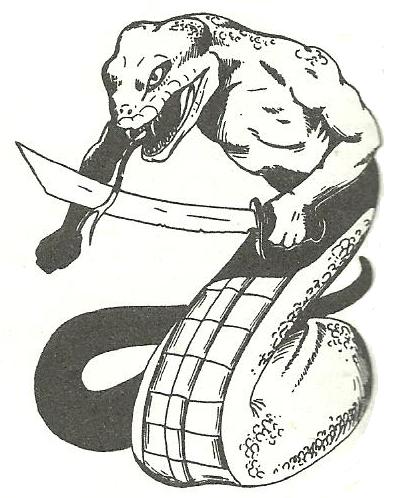
A race of evil, genius, psionic, demon-worshiping, jungle-dwelling snake-men... Win! Hard to beat that for a nice villain for fantasy high adventure.

They join the Duergar, the Su-Monsters, and the Gith in the ranks of humanoid-ish races that are entirely psionic.

Between their high hit points, their psionic powers, their magic resistance, their powerful physical attacks, and their genius INT, an adventure among the Yuan Ti would be VERY dangerous.

In the AZ Adventures campaign, the Yuan Ti homeland is slightly "off the map", down in the jungles of Mexico. Subject for a long-range adventure, perhaps. The interaction of the jungle-dwelling but good-aligned Coualt with the evil-aligned Yuan Ti would be a very interesting plot line to work out.

They are in the perfect location: close enough to be on the periphery of awareness, to provide small parties of wandering Yuan Ti in encounters in the main campaign area.

"Pureblood" Yuan Ti, those who look almost human, could also be found ranging the land, posing as ambassadors, perhaps, looking for areas of migration and conquest, while cultivating evil allies.

Keep in mind their polymorph-other power! They would polymorph their kidnap victims for easy transport, as well as for various other evil purposes.

For example, they could be posing as a traveling circus/menagerie. Of course, their menagerie would be polymorph victims!

Although the text only mentions "demon worship", it seems obvious to me that they are worshipers of Marilith (see here: http://oldschoolpsionics.blogspot.com/2011/04/m-is-for-marilith-to-z-psionic-monsters.html). No doubt, it was their worship of the demon snake lady which caused this group of former-humans to degenerate into their snake form, in exchange for their tremendous psionic and magic-resistant powers.

HD: 6-9
attacks: depending on form: bite, tail or weapons attack
INT: Genius
Magic resistance: 20%

Psionic Ability: 150
attack modes: Mind Thrust, Id Insinuation
defense modes: Mind Blank, Intellect Fortress, Tower of Iron Will

Special powers (human-headed only):

1x per day:
cause fear
darkness (15' radius)
snake charm
stick to snakes
neutralize poison
suggestion
polymorph other

Thursday, April 28, 2011

X is for Xag-ya and Xeg-yi - A to Z psionic monsters


Floating balls of pure energy and anti-energy, that is what we are talking about here. The idea is definitely more sci-fi-fantasy than traditional fantasy.

The 1e MM2 suggests they would be used mainly as guardian monsters, summoned to deal with theft.

They would also be cool if used as a "bodyguard" monster of some wizard, tagging along with him, operating at his beck and call.

Also, they would make a very spooky and intimidating "assassination" monster, sent by a wizard to kill his enemies.

Another nice plot hook would be to have one of these locked into a cube of force in some mad wizard's lab. Of course, it would escape, mess up the wizard in the process, and take off to float aimlessly through the countryside (or underground)...

However you use them, they would be unusual and mysterious. They have no natural ecology, and they are "mindless by human standards", meaning some sort of alien intelligence, nothing in common with us at all in terms of motivation or empathy.

HD 5-8
attacks: tendril slap or energy blast (7-12 damage)
INT: High
Magic Resistance: 15% (+1 or better to hit)

Psionic Ability:130-180
attack/defence modes: all/all

Psionic powers: none listed, but it would make sense (and make them more bad ass) to equip them with Energy Control and Telekinesis.

Wednesday, April 27, 2011

Random encounter table for Psionic monsters - underground, above ground, and astral

[Well, there is no W psionic monster, so today I am going with this]

The DMG recommends that anytime psionics or psionic-like spells are used, there is a 1 in 4 chance that the next random encounter will be with a psionic monster.

Here are some exapanded tables of my devising, with all 1e psionic monsters included

Psionic Encounter Tables

Underground

01-05 Aboleth
06 Agathion
07 Baku
08-11 Brain mole
12-15 Cerebral parasite
16 Couatl
17-20 Crysmal
21-24 Demon, major (type 5 or 6)
25-29 Demon, minor (type 1-4)
30-31 Demon, prince
32 Deva/Planetar/Solar
33-34 Devil, arch
35-39 Devil, greater
40-50 Duergar
51 Enveloper
52-55 Githyanki
56-57 Githzerai
58-62 Gray ooze
63 Hollyphant
64-70 Intellect Devourer
71-75 Lich
76-80 Men (human psionic)
81-84 Mind Flayer
85 Modron
86-88 Mold, yellow
89 Shedu
90 Slaad
91-94 Su-monster
95 Thought Eater
96 Titan
97 Ustilagor
98 Vagabond
99 Xagya & Xegyi
00 Yochlol


Above Ground

01-05 Algoid
06-07 Agathion
08-09 Baku
10-15 Brain mole
16-20 Cerebral parasite
21-25 Couatl
26-29 Demon, major (type 5 or 6)
30-34 Demon, minor (type 1-4)
35-36 Demon, prince
37 Deva/Solar/Planetar
38-39 Devil, arch
40-44 Devil, greater
45-46 Elemental Princes
47 Enveloper
48 Foo Creatures
49 Githyanki
50 Githzerai
51 Gray ooze
52-53 Hollyphant
54 Intellect Devourer
55-59 Ki-rin
60 Lich
61-70 Men (human psionic)
71 Mind Flayer
72 Modrons
73-75 Mold, yellow
76 Opinicus
77 Phoenix
78-80 Shedu
81 Slaad
82-86 Su-monster
87 Thought Eater
88-89 Titan
90 Ustilagor
91-92 Vagabond
93-94 Xagya & Xegyi
95Yochlol
96-00 Yuan Ti


Astral Plane

01-03 Agathion
04-05 Baku
06-12 Cerebral parasite
13-15 Couatl
16-18 Demon, major (type 5 or 6)
19-24 Demon, minor (type 1-4)
25-26 Demon, prince
27-33 Deva/Planetar/Solar
34-35 Devil, arch
36-40 Devil, greater
41-42 Foo Creatures
43-52 Githyanki
53-59 Githzerai
60-61 Hollyphant
62 Intellect Devourer
63-64 Ki-rin
65-67 Lich
68-73 Men (human psionic)
74-79 Mind Flayer
80 Modron
81 Opinicus
82 Phoenix
83-84 Shedu
85-87 Slaad
88-91 Thought Eater
92 Titan
93-94 Vagabond
95-96 Xagya & Xegyi
97-99 Yochlol
00 Yuan Ti


The original table was confined to 1e MM:

01-05 Brain mole
06-12 Cerebral parasite
13-15 Couatl
16-18 Demon, major (type 5 or 6)
19-24 Demon, minor (type 1-4)
25-26 Demon, prince
27-28 Devil, arch
29-34 Devil, greater
35-38 Gray ooze
39-48 Intellect Devourer
49-51 Ki-rin
52-56 Lich
57-62 Men (human psionic)
63-69 Mind Flayer
70-72 Mold, yellow
73-82 Shedu
83-92 Su-monster
93-98 Titan
99-00 Triton

Tuesday, April 26, 2011

V is for Vagabond - A to Z psionic monsters

Welcome to Invasion of the Body Snatchers! Or, maybe, more like, Cocoon... I dunno, but whatever the case, a Vagabond is some kind of weird E.T. spirit that takes human (or other) form.

Vagabonds want to figure things out... They are curious, naive... They want to see new places... explore new surroundings, that kind of thing. They are like curious little children who don't understand anything, but have a zest for exploration and figuring things out.

Honestly, they sound fun to role play. I think there was a movie back in the 80's with this premise. Jeff Bridges comes to mind, but can't remember the movie title...

Another example I can think of would be the early Data character on the new Star Trek. A total oddball with no social skills, incredibly intelligent, always asking weird questions...

They might even agree to join the adventure! Oh yes, now we are talking! Because if they complete an adventure, they will even leave behind a cool magic gift! This would be a cool ally to have if you are about to send your players off on a "psionic campaign".
HD: depends on the form they take
attacks: depends on form
INT: Genius to Supra-genius

Psionic ability: 201-300
attack/defense modes: all/all

Psionic powers:

None listed, but it would be cool to give them some, stuff that really solidifies their status as "powerful alien creature", like Cell Adjustment (healing), Energy Control, ESP, Precognition, Levitation, that kind of thing


Special powers:
immunity to mind control

Monday, April 25, 2011

U is for Ustilagor - A to Z psionic monsters

Ustilagor.... what can we say... not exactly a classic old-school monster... To tell you the truth, before this article, I had no idea what this even looked look, having never heard of it.

From the "semi-sentient fungus" files, it looks kinda like a brain which can scuttle around like a crab... with caustic alkaline (not acid!!!) tendrils that can whip you in the face. Definitely a creative concept.

While not huge game-changers for a campaign, they definitely provide another interesting random monster encounter for the psionic adventure.

I get the definite impression these things would exist in a symbiotic relationship with some other more-intelligent monsters. Perhaps they are created or cultivated by Mind Flayers, Aboleths, Duergars, or Githyanki as some sort of guardian pets. [Later editions turned this thing into an Intellect Devourer larva... I'm not sure I'd go in that direction.]
HD: 3+3
attacks: 1 tendril slap (2-5 damage + caustic alkali)
INT: n/a

Psionic Ability: 155-180
attacks: Id Insinuation
defense: Mind Blank + immune to all but Psionic Blast

Psionic powers:
Telempathic projection: hate or distrust for associate, fear of fungi, loathing of area, uncertainty
Energy control

Saturday, April 23, 2011

T is for Thought Eater - A to Z psionic monsters


I don't care what anybody says, this is a cool monster. Alright, admittedly, I think the problem is the picture. Some kind of weird flying duck, not exactly epic, yeah, I get that.

But when you consider this thing as an example of a creative, fun, and frankly HORRIFIC monster to throw at your players, well, it is hard to beat. If the duck-image throws you off, just change it so it looks like some bad-ass little demon-looking thing. It doesn't matter what it looks like, it is invisible in the ethereal state anyway.

--Imagine your spells just being eaten in midair... Could be a real disaster in the middle of a battle...

--Then, your head starts to get woozy and you go all glassy eyed as this thing starts feeding on your mental energy...

If you can turn ethereal, you can just wack these things to death (since they have AC 9 and no physical attacks). But if you can't turn ethereal, you could be in for a real rough time.

It has an emaciated look because, like the Githyanki, it is a physical being which spends most of its time in an ethereal state. Like the undead (and probably the Githyanki to a limited degree), it eats the spirit energy of living creatures.

Any psionic or psionic-like powers attract their attention. It will consume psionic and magical power first, and feed directly on someone's INT points if it doesn't get enough psionics or psionic-like magic energy

--Psionic-like magic is considered 5 psionic points per spell level;
-- 1 INT point equals 10 psionic points.
-- it will need to eat 101-200 psionic points before it breaks of its attack (10-20 INT points, yikes!)

You definitely want to add these nasties to your encounter tables, even if you don't have psionics per se, because they are attracted to the psionic-like magic too.


HD: 3
INT: non

Psionic ability: nil